
Most plastic injection molds are built from one of four steels: P20, 718H, NAK80 or S136. Pick the cheapest one that still meets your shot-life, surface-finish and corrosion requirements. P20 suits textured, lower-volume tools; 718H handles larger and longer-running tools; NAK80 delivers mirror polish without heat treatment; and S136 is the choice when you need corrosion resistance or the highest gloss at a hardened condition.
The four steels at a glance
| Steel | Supplied condition | Typical hardness | Best known for |
|---|---|---|---|
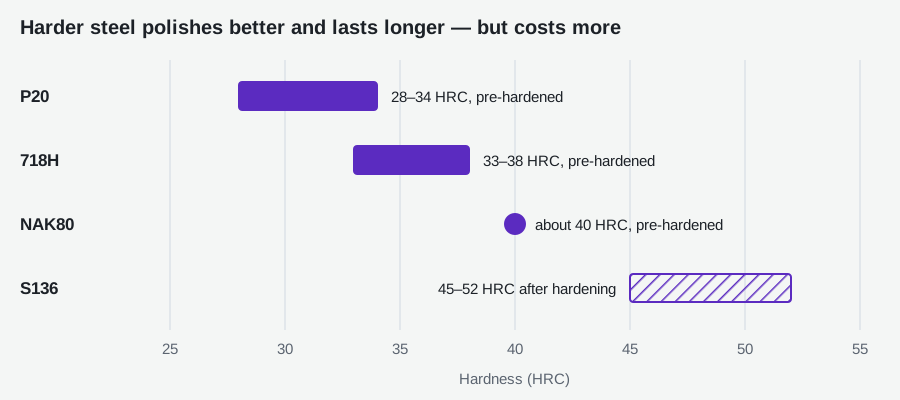
| P20 | Pre-hardened | 28–34 HRC | Low cost, easy machining, textured parts |
| 718H (P20 + Ni) | Pre-hardened | 33–38 HRC | Better through-hardness in thick blocks, longer runs |
| NAK80 | Pre-hardened | about 40 HRC | Mirror polish and texture etching with no heat treatment |
| S136 / Stavax ESR | Soft annealed (about 190 HB), then hardened | 45–52 HRC working hardness | Corrosion resistance, high polish, abrasive or corrosive resins |
Hardness values are typical supplier figures; always confirm against the certificate that comes with your block.
P20: the default for everyday molds
P20 is delivered pre-hardened at roughly 28–34 HRC, so it can be machined straight away without a heat-treatment step. It is the cheapest of the four and the easiest to cut, which keeps both steel and machining costs down.
Its limits show up in two places. Polishing is limited: P20 is usually finished to textured surfaces (around VDI 24–36) or SPI B-2 to C-1, not a true mirror. And shot life is moderate — commonly quoted at up to about 500,000 shots for commodity resins such as PP, PE and ABS.
Choose P20 when: the part is textured or non-cosmetic, volumes are below a few hundred thousand shots, and budget matters.
718H: P20 with more nickel for bigger, longer-running tools
718H is essentially a P20-type steel with about 1% nickel added. The nickel improves hardenability, so a thick block keeps a more uniform hardness from the surface to the core. It is delivered at about 33–38 HRC.
The trade-off is cost: 718H is typically 40–50% more expensive per kilogram than P20 and slightly slower to machine. In return it supports longer runs — roughly 500,000 to 1 million shots — and polishes better, up to about SPI A-2 to B-1 for semi-gloss and high-gloss consumer parts.
Choose 718H when: the mold is large, the program runs beyond roughly 300,000–400,000 shots, or you need a better cosmetic finish than P20 can give. On a mid-size mold the steel premium over P20 is often only 5–10% of the total tool cost.
NAK80: mirror polish without heat treatment
NAK80, made by Daido Steel, is delivered pre-hardened at about 40 HRC. Its main selling point is cleanliness: very few inclusions, which is why it takes a mirror polish with a lower risk of pits and "orange peel" during the slow, skill-intensive polishing stage.
Because it needs no heat treatment, NAK80 avoids the distortion and dimensional change that hardening can cause, which shortens lead time for precision cavities. It is also well suited to photo-etched textures, and Daido publishes repair-welding conditions with a post-weld aging treatment (500 °C for 5 hours) so that weld repairs blend into a polished or textured surface.
Choose NAK80 when: the part is cosmetic or transparent, you need a high polish or a uniform texture, and you want to skip heat treatment. Typical uses include appearance-critical consumer parts and lighting components such as automotive headlamp reflectors.
S136 (Stavax ESR): when corrosion or the highest gloss matters
S136 is ASSAB's name for the stainless mold steel Uddeholm sells as Stavax ESR. Unlike the other three, it is delivered soft annealed (about 190 HB) and is hardened after rough machining to a working hardness of 45–52 HRC. That extra step costs time and money, but the result is a hard, corrosion-resistant cavity.
Corrosion resistance matters more than many buyers expect. It keeps cooling channels free of rust — which protects cycle time over the life of the tool — and keeps polished surfaces from degrading in humid storage. The supplier recommends it for corrosive plastics such as PVC and acetates, for abrasive or filled materials, for long-running thin-wall packaging, and for high-gloss optical and medical parts such as lenses and syringes.
Choose S136 when: you mold PVC or other corrosive resins, run filled or abrasive materials, need optical-grade gloss, or the tool will run or be stored in a humid environment.
A quick decision guide
- Is the resin corrosive (PVC, acetates) or the part optical/medical? → S136.
- Does the part need a mirror finish or a fine etched texture, without heat treatment? → NAK80.
- Is the mold large or expected to exceed about 300,000–400,000 shots? → 718H.
- Otherwise — textured or hidden parts, moderate volumes, tight budget → P20.
Many molds mix steels: a P20 or 718H mold base and plates, with NAK80 or S136 inserts only where the cosmetic surface or corrosion risk actually is. That keeps cost down while putting the premium steel where it earns its price.
Common mistakes when choosing mold steel
- Specifying a mirror finish on P20. It is not a mirror-polish steel; the polisher will fight pits and the result will disappoint.
- Ignoring the cooling channels. In humid plants, non-stainless steels can rust inside the water lines, slowly reducing cooling efficiency and stretching cycle time.
- Comparing steel price only. Steel is a small share of total mold cost; machining time, heat treatment, polishing hours and tool life usually matter more.
- Forgetting heat-treatment distortion. Through-hardened steels need allowance for movement after hardening; pre-hardened steels such as NAK80 avoid that step.
Frequently asked questions
Is NAK80 better than 718H?
For polish, yes — NAK80 is harder (about 40 HRC versus 33–38 HRC) and cleaner, so it reaches a higher gloss. For large, non-cosmetic tools, 718H is usually the more economical choice.
Do I need to heat treat S136?
Yes. Stavax ESR / S136 is supplied soft annealed and is normally hardened to 45–52 HRC after rough machining.
Can P20 be used for clear parts?
It is not recommended. Clear and high-gloss parts need a cleaner steel that polishes to a mirror, such as NAK80 or S136.